Self-Hosting LLMs Demands Significant Hardware, Patience, and Careful Iteration
Summary
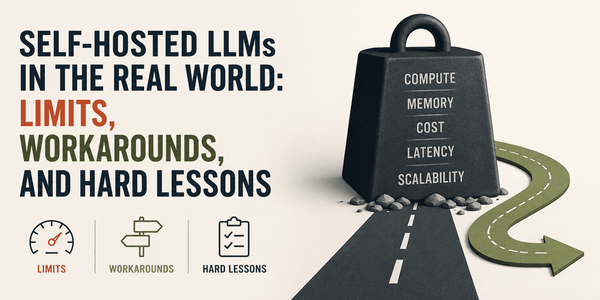
Self-hosting large language models is a hardware-intensive, patience-demanding endeavor requiring at least 16GB of VRAM for even modest models, with operational friction from RAG pipelines, prompt template mismatches, and latency issues making it far from a seamless API replacement.
Key Points
- Self-hosting LLMs presents significant hardware challenges, as running even a 7B parameter model requires at least 16GB of VRAM, and scaling to larger models demands multi-GPU setups or quality-compromising quantization trade-offs.
- Operational friction compounds through multiple layers including shrinking context windows in RAG pipelines, model-specific prompt templates that break when switching between hosted and self-hosted environments, and latency issues that slow development cycles to a crawl.
- Fine-tuning offers a path to domain-specific performance but demands clean, curated training data over large noisy datasets, with the broader takeaway being that self-hosting rewards patience and iteration rather than serving as a frictionless drop-in API replacement.