OpenAI Unveils Open-Weight Language Model for Public Access
OpenAI unveils an open-weight language model accessible to the public through cloud providers like Azure and Hugging Face, marking its first open release since partnering with Microsoft.
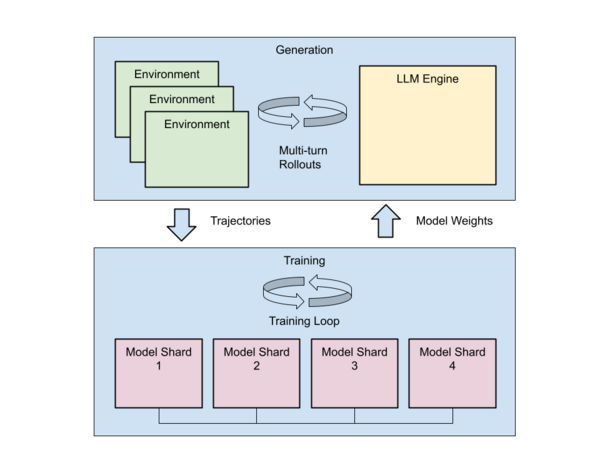
Reinforcement learning, fueled by a rapidly expanding open-source ecosystem with diverse libraries, is driving advancements in large language models, enabling optimization for properties like adoption, components like trainers and generators, and use cases like Reinforcement Learning from Human Feedback and multi-turn agentic RL.
Researchers unveil Hunyuan-A13B, a groundbreaking 80B-parameter open-source AI model that employs a fine-grained Mixture-of-Experts architecture, delivering competitive performance while optimizing efficiency and scalability across various benchmarks.
In a bold move shaking up the generative AI landscape, Chinese tech giant Baidu releases its powerful Ernie large language model as open source, sparking debate over potential disruption and China's AI leadership while pressuring closed AI providers like OpenAI.
Google unveils Gemini CLI, an open-source AI agent that empowers developers' terminals with unmatched usage limits, offering 60 model requests per minute and 1,000 requests per day for free, leveraging the same technology as Gemini Code Assist.
IBM fortifies AI prowess by acquiring natural language data querying startup Seek AI and unveiling $500M Watsonx AI Labs in NYC to co-develop enterprise-ready AI solutions for cybersecurity, customer service, and open-source frameworks.
Mistral unveils Magistral, a new AI language model family, including the 24-billion parameter open-source Magistral Small and the proprietary Magistral Medium for enterprises, promising enhanced reasoning capabilities.
A/B Street is an open-source initiative revolutionizing urban mobility by providing software tools to simulate traffic, design streets, plan bike networks, create low-traffic neighborhoods, and educate the public through interactive games, all using OpenStreetMap data.
Indie game developer Noel Berry shares his unconventional workflow of making video games in 2025 without using commercial game engines, opting instead for lightweight open-source libraries and custom tools tailored to his specific needs for greater control, portability, and avoiding potential ethical concerns with proprietary software.
VS Code embraces open source AI by releasing the code for GitHub Copilot Chat under MIT license and integrating AI features into its core, enabling community contributions, transparency, and addressing security concerns while maintaining performance and user experience.